





Plaumann group
Molecular Biology and Medicinal Chemistry
Molecular sensors, cellular systems, multinuclear NMR and hyperpolarized spectroscopy
The Plaumann group integrates molecular biology and medicinal chemistry to develop and apply molecular systems for the analysis of biological processes. Central to this work is the combination of cell-based and molecular biological approaches with chemical synthesis and advanced NMR spectroscopy.
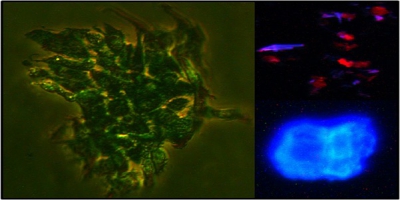
In molecular biology, cellular systems and experimental models are used to investigate the stability, interactions, and biological effects of developed compounds. A particular focus lies on supramolecular host–guest systems, which enable and control the transport of molecules across and through cellular membranes. Radiochemical approaches further provide detailed insights into metabolic processes and molecular transformations.
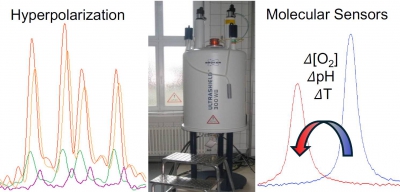
Medicinal chemistry focuses on the development of fluorinated molecular sensors as well as the application of multinuclear NMR spectroscopy to complex systems. Hyperpolarization methods (PHIP, SABRE) enhance these approaches by increasing sensitivity.
By closely integrating both areas, the group contributes to the development of novel molecular tools for analyzing biological systems and for the early detection of disease-related changes.
Research Areas
| Molecular biology | Medicinal Chemistry |
 |
 |
|
|
Selected Publications
Parahydrogen‐based hyperpolarization for biomedicine
J.-B. Hövener, A. N. Pravdivtsev, B. Kidd, C. R. Bowers, S. Glöggler, K. V. Kovtunov, M. Plaumann, R. Katz-Brull, K. Buckenmaier, A. Jerschow, F. Reineri, T. Theis, R. V. Shchepin, S. Wagner, P. Bhattacharya, N. M. Zacharias, E. Y. Chekmenev
Angew. Chem. Int. Ed. 2018, 57, 11140
T. Houben, F. Mysegaes, J. Z. Myers, N. Kempf, C. D. Assaf, A. N. Pravdivtsev, K. Buckenmaier, R. Körber, M. Plaumann
ChemPhotoChem 2024, 8, e202400106
Direct detection of SABRE-SHEATH hyperpolarization and spin-lattice relaxation of [1-13C] pyruvate
J.Z. Myers, M. Plaumann, K. Buckenmaier, A. N. Pravdivtsev, R. Körber
Direct detection of SABRE-SHEATH hyperpolarization and spin-lattice relaxation of [1-13C]pyruvate
Commun Chem 2026, 9, 44
F. Mysegaes, P. Spiteller, J. Bernarding, M. Plaumann
ChemPhysChem 2023, 24, e202300057
Two fluorinated thulium complexes as molecular temperature sensors in MR applications
F. Mysegaes, P. Voigt, P. Spiteller, I. Prediger, J. Bernarding, M. Plaumann
Chem. Commun. 2023, 59, 9340-9343
More Publications
- Google Scholar (https://scholar.google.de/citations?hl=de&user=bhSTS1oAAAAJ)
Methods & Infrastructure
- Multinuclear NMR spectroscopy (¹H, ¹³C, ¹⁹F, ³¹P, etc.)
- Hyperpolarization techniques (PHIP, SABRE)
- Cell culture and cell-based assays
- Fluorescence microscopy and laser microdissection
- FPLC and biochemical analysis
- Radiochemistry (³H, ¹⁴C, ³²P)
Cooperations
- MPI Tübingen
- TU Darmstadt
- CAU Kiel (MOIN CC)
- PTB Berlin
- University of Bremen
Team
Head: Prof. Dr. rer. nat. Markus Plaumann
Secretary: Daniela Lorenz
- Maria Ananiadou, M. Sc.
- Faegheh Kamyabi, M. Sc.
- Jana Reising
- René Stürmer
- Laurin Vinca
- Dr. rer. nat. Natalie Waldt
- Dr. rer. nat. Eva Znalesniak
Contact & Collaboration
We welcome scientific collaborations in molecular sensing, NMR-based analytics, and applications in molecular and cellular systems.
Contact: immc.sekretariat@med.ovgu.de